A strong core is more than just visible abs. It supports your spine, improves posture, enhances balance, and reduces the risk of injuries. One of the most effective ways to train your core muscles is by performing plank exercises regularly.
Planks are simple, equipment-free, and highly effective. Whether you are a beginner or an advanced fitness enthusiast, plank variations can be modified to match your strength level and fitness goals.
Why Plank Exercises Are Essential for Core Strength
Plank exercises are one of the most effective movements for building true core strength because they engage multiple muscle groups simultaneously. Unlike isolation exercises that target only the abs, planks activate the deep core muscles, including the transverse abdominis, obliques, lower back, glutes, and shoulders. This full-body engagement makes planks highly efficient and functional.
Another major benefit of plank exercises is that they strengthen the core while placing minimal stress on the spine. Traditional ab workouts like sit-ups and crunches involve repeated spinal flexion, which can lead to discomfort or injury over time. Planks, on the other hand, keep the spine in a neutral position, making them safer for long-term core training when performed correctly.
Planks also focus heavily on stability, endurance, and total-body control. Holding a plank position teaches your muscles to work together to support proper alignment and posture. This carries over into daily activities, sports performance, and weight-training exercises by improving balance and movement efficiency.
19 Best Plank Exercises To Build a Strong Core
1. Standard Forearm Plank
The forearm plank is the foundation of all plank variations. Keep your elbows directly under your shoulders and maintain a straight line from head to heels. Engage your abs, glutes, and thighs to hold proper form.
Targets: Core, shoulders, lower back
2. High Plank
The high plank is performed with arms fully extended, similar to a push-up position. This variation increases upper-body engagement while still activating the entire core. Keep your hips steady and core tight throughout.
Targets: Abs, shoulders, arms
3. Side Plank
Side planks are excellent for strengthening the obliques. Balance your body on one forearm while stacking your feet. Keep your hips lifted and spine aligned to maximize core activation and stability.
Targets: Obliques, hips, core stabilizers
4. Side Plank With Hip Dips
This variation adds movement to the side plank. Lower your hips slightly toward the floor and lift them back up in a controlled manner. This increases intensity and improves oblique muscle endurance.
Targets: Obliques, deep core muscles
5. Plank With Shoulder Taps
From a high plank position, alternate tapping your shoulders with the opposite hand. Keep your hips as still as possible. This exercise challenges balance while strengthening the core and shoulders.
Targets: Core, shoulders, coordination
6. Reverse Plank
The reverse plank is performed facing upward with hands and heels on the floor. Lift your hips until your body forms a straight line. This exercise strengthens often-neglected posterior core muscles.
Targets: Lower abs, glutes, lower back
7. Plank Jacks
Plank jacks combine core strength with cardiovascular movement. While holding a high plank, jump your feet out and back together. Maintain a stable upper body throughout the movement.
Targets: Core, legs, cardiovascular endurance
8. Walking Plank
Walking planks involve transitioning between forearm and high plank positions. This dynamic movement increases time under tension and improves shoulder and core strength simultaneously.
Targets: Core, arms, shoulders
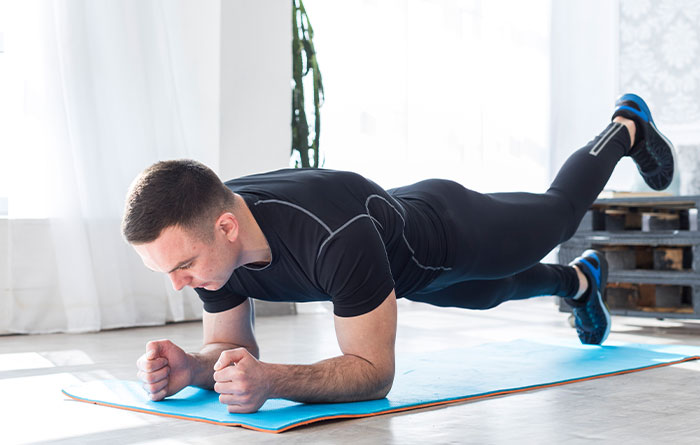
9. Plank With Leg Lift
In a standard plank position, lift one leg at a time while maintaining balance. Avoid shifting your hips. This variation activates the glutes while forcing the core to stabilize the body.
Targets: Core, glutes, lower back
10. Spiderman Plank
From a high plank, bring one knee toward the elbow on the same side. Alternate sides slowly and with control. This rotational movement increases oblique and hip mobility.
Targets: Obliques, hip flexors, abs
11. Plank With Arm Reach
While holding a plank, extend one arm straight in front of you. Keep your hips and shoulders stable. This variation strengthens deep core muscles responsible for balance and posture.
Targets: Core stabilizers, shoulders
12. Plank to Pike
Start in a plank position and lift your hips upward into a pike shape. Slowly return to the plank. This movement engages the abs dynamically while also strengthening the shoulders.
Targets: Upper abs, shoulders
13. Stability Ball Plank
Placing your forearms on a stability ball increases instability, forcing your core muscles to work harder. Maintain a neutral spine and tight core throughout the hold.
Targets: Core stabilizers, abs
14. Plank With Knee to Chest
From a high plank, pull one knee toward your chest and return to start. Alternate sides while maintaining proper alignment. This exercise emphasizes lower abdominal strength.
Targets: Lower abs, core control
15. Plank Saw
The plank saw involves rocking your body forward and backward while holding a forearm plank. This increases core tension and challenges shoulder stability and abdominal endurance.
Targets: Abs, shoulders
16. Single-Arm Plank
Lift one arm off the floor while holding a plank position. Keep your hips square and core tight. This advanced variation demands high levels of balance and strength.
Targets: Core balance, deep stabilizers
17. Plank With Toe Taps
While holding a plank, tap one foot out to the side and return it to center. Alternate sides slowly. This movement improves coordination and lateral core strength.
Targets: Core, hips
18. Extended Plank
In an extended plank, position your elbows slightly ahead of your shoulders. This increases the lever length, placing greater demand on the abdominal muscles and shoulder stability.
Targets: Upper abs, core endurance
19. Weighted Plank (Advanced Variation)
Place a light-weight plate on your upper back while holding a standard plank position. Keep your body aligned and core braced. This advanced variation significantly increases resistance and builds full core strength.
Targets: Full core strength
Common Plank Mistakes To Avoid
Although plank exercises look simple, many people perform them incorrectly, which reduces effectiveness and increases the risk of injury. One of the most common mistakes is letting the hips sag toward the floor. This puts unnecessary pressure on the lower back and shifts the focus away from the core muscles.
Another frequent error is raising the hips too high. While this may feel easier, it reduces abdominal engagement and turns the plank into more of a resting position than a strength exercise. Holding your breath during a plank is also a major mistake. Proper breathing helps maintain endurance and keeps your core muscles activated.
Incorrect elbow or hand placement can also lead to shoulder strain. Your elbows should be directly under your shoulders, and your wrists should align properly in a high plank. To get maximum benefits, always focus on slow, controlled breathing, tightening your abs, squeezing your glutes, and maintaining a neutral spine throughout the movement.
How Often Should You Do Plank Exercises?
Plank exercises can be safely performed three to five times per week, depending on your fitness level and recovery ability. Beginners should start with fewer sessions and shorter hold times, gradually increasing as strength improves. More advanced individuals can include planks more frequently or use challenging variations.
You can add plank exercises at the end of your regular workout as a finisher, or you can create a dedicated core routine focused entirely on plank variations. Since planks train muscle endurance rather than explosive power, they do not require long recovery periods like heavy lifting.
However, quality always matters more than quantity. Short, well-performed plank holds with proper form are far more effective than long holds done with poor posture.
Final Thoughts
Plank exercises are one of the most effective and versatile tools for building a strong, stable, and functional core. They engage multiple muscle groups at the same time, improve posture, enhance balance, and support overall body strength.
With these 19 plank variations, you can challenge your core from every angle while preventing workout boredom. Whether you are a beginner or an advanced fitness enthusiast, planks can be adjusted to match your strength level and goals.
Stay consistent, focus on proper form, breathe steadily, and gradually increase difficulty over time. With regular practice, plank exercises can significantly improve your core strength and overall fitness.
FAQs
Q1. Are plank exercises good for beginners?
Ans: Yes, plank exercises are excellent for beginners because they can be easily modified. Beginners can start with knee planks or shorter hold times and gradually progress as core strength improves.
Q2. Do planks help reduce belly fat?
Ans: Planks strengthen and tone core muscles, but fat loss depends on overall calorie burn and diet. Combining plank exercises with cardio and proper nutrition produces the best results.
Q3. Is it safe to do planks every day?
Ans: Planks can be done daily if performed correctly and without pain. However, most people benefit from doing them three to five times per week to allow muscles adequate recovery.
Q4. How long should I hold a plank for the best results?
Ans: Beginners can start with 20–30 seconds, while intermediate and advanced individuals can aim for 45–90 seconds. Proper form is more important than holding time.
Q5. Can planks help with lower back pain?
Ans: Yes, planks can help strengthen muscles that support the spine, which may reduce lower back pain. However, correct form is essential, and anyone with existing pain should consult a professional first.
Q6. Which plank variation is the most challenging?
Ans: Advanced variations such as weighted planks, single-arm planks, and extended planks are among the most challenging because they demand greater stability and core control.

Sahil Sachdeva is the Founder of curemedoc.com and a Digital Marketing professional with years of experience. If you need help in Content writing and want to increase your website ranking, connect with him, as he has some premium websites where you can share blogs with DoFollow links and increase your website’s ranking on Google.